Five Years of Ground News Ads: What Sold a Media Bias App on Meta and Google
By Kevin Veitia
- Client
- Ground News, a news comparison and media bias app
- Channels
- Twitter Ads (2020), Meta Ads, Google Ads (Search, Performance Max and App campaigns)
- Markets
- United States, United Kingdom and worldwide
- Timeframe
- 2020 to 2025
- Engagement
- Paid media lead, measurement and landing pages
The challenge
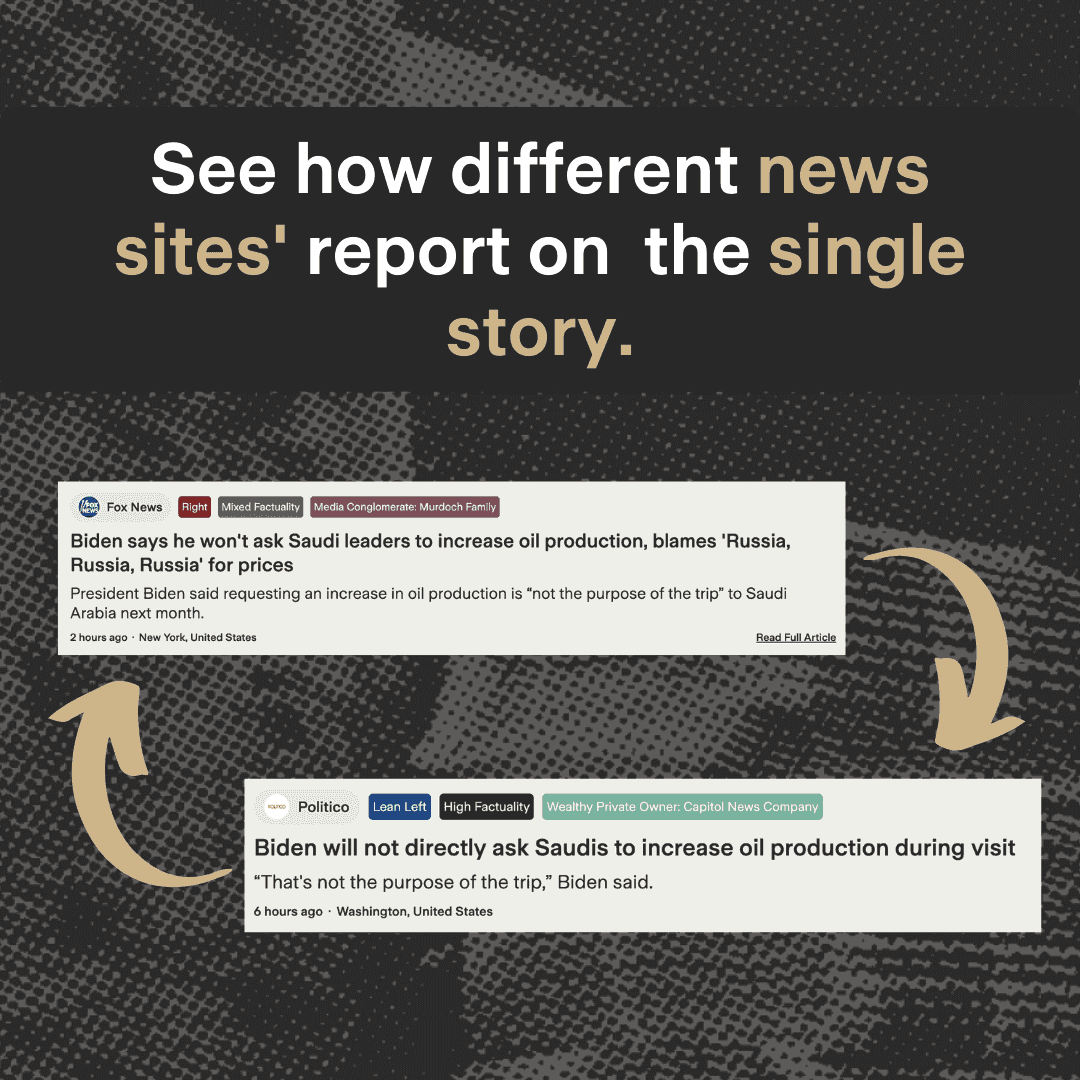
Ground News shows you how outlets across the political spectrum cover the same story, with a bias bar that breaks down who's reporting what. Great product. Brutal category. Almost nobody pays for news, and politics is about the most sensitive thing you can run ads on.
We started with Ground News in 2020, and the first brief was Twitter. The campaigns were optimized for link clicks, and the best we got was about $0.10 a click. Sounds cheap. It's meaningless. A link click isn't a customer. Traffic campaigns teach the algorithm to find people who tap things, not people who install, register and pay. And cheap clicks are exactly where fat-finger taps and click fraud pile up.
We pushed hard to stop buying traffic and start buying acquisitions. Twitter's ad platform couldn't deliver that, so the money moved to Meta, and later Google. What followed was five years through a pandemic, two election cycles, Apple blowing up tracking, and more channel shuffles than we can count. Here's what actually worked.
2020: Let the ad be the demo
2020 was peak news. COVID, misinformation, the end of a very loud presidential term. Everyone had media bias on the brain.
The winning creative was stupidly simple: a screenshot of a real story Ground News had aggregated, with the bias bar slapped on top. No lifestyle footage. No explainer video. Just the app doing its job on a story you already cared about.
Why it works: the endowment effect. People value things more once they feel like theirs. In the classic experiments, people who were handed an object asked about twice as much to give it up as others would pay to buy it. An ad that lets you use the product, read the breakdown and form an opinion gives you a taste of owning it before you ever install.
We also optimized for app opens, not installs. Apps routinely lose 40 to 50% of people between install and first open. Optimize for installs and you train the platform to find people who download and ghost. We picked a deeper event with enough volume, around 50 per ad set, so the algorithm learned to find actual readers.
At the 2020 peak, with lookalikes still at full power before iOS 14.5, US installs cost about $0.25.
The election: the Trump effect
Election season drags every advertiser in America into the same auction. CPMs spiked and US installs climbed to around $3.75, way over target. We needed to know which creative still deserved money, so we variabilized everything.
Variabilized advertising is what we call building ads as templates and changing one thing at a time, so every test isolates a single variable. The template stayed fixed: a real headline with the bias bar underneath. The only thing that changed was the face. Trump vs. Biden in the general, Sanders vs. Biden in the primaries, and so on.
One result blew everything else away. Put Trump in the ad and installs jumped. Nobody else came close. It wasn't about politics. It was about a face every single person had an opinion on, next to an app promising to show you how the coverage was slanted.
It came with a price. Polarizing creative gets reported, and enough reports can restrict an ad account whether or not you broke a single rule. If you advertise on sensitive topics, you need policy knowledge and a contingency plan from day one, not after the first restriction.
2021 to 2023: The UK pivot
After the election, US installs settled at around $2 to $3.75. Instead of fighting that auction forever, we went looking for a market where the same ads would work harder. The UK turned out to be the best market we ever had.
The reason: the Brits argue. In the comments, about the story, about the outlets, with each other. Meta's delivery favors ads that get engagement, so all that arguing made our ads cheaper to serve than the exact same ads in the US. We moved most of the budget to the UK, got installs down to $0.75, and held that for about two years.
The Trump effect traveled too. In the UK, it was Boris Johnson. Same formula: a Johnson story, the bias bar, the outlet logos. Everybody had an opinion. That's the whole trick.
What's an install actually worth?
As spend grew, the question changed from what an install costs to what it's worth. Ground News needed to know how many paid installs turned into subscribers, and the tracking to answer that directly wasn't fully set up.
Our recommendation: model it, don't wait. Blended install-to-subscription was around 3%, roughly 2% on Android and 4% on iOS. If you think branded or organic users convert better than paid, fine. Weight paid down, even as low as 1%. An imperfect model you can tweak beats quietly assuming paid installs convert at zero. That assumption is just as unproven, and a lot more expensive.
2022 to 2025: Scaling Google Ads
We started testing Google Ads alongside Meta in 2022, and it worked early, returning around 200% ROAS. Over the next few years the budget shifted to Google and scaled to six figures a month across Search, Performance Max and App campaigns working together. We built dedicated search landing pages to replace a rigid template, and rebuilt measurement as cookie-consent rules changed, using offline conversion uploads so the numbers stayed trustworthy.
Scaling brought two fights every subscription app has eventually.
Month-one ROAS. Wanting ads to pay for themselves in 30 days makes sense when cash is tight. But when subscribers stick around for more than a year, judging channels on month one undervalues every one of them. We judge channels on lifetime value.
Branded search. Ground News has a big YouTube presence, so a fair question was how much branded search YouTube was creating and paid search was just catching. Our take: measure YouTube and paid search together against the target, and test incrementality before you cut anything. The landing page behind those branded campaigns converted at about 4%, versus about 0.003% on the homepage. Even if every one of those searchers came from YouTube, dumping them on the homepage would have lost most of them.
Results
- 250,000+ app installs
- About $0.25 per US install at the 2020 peak
- $0.75 per install in the UK, held for about two years, against $2 to $3.75 in the US
- $0.46 average cost per install on Meta worldwide, as low as $0.33 on Android segments
- Subscriber base quadrupled
- Google Ads scaled to six figures a month across Search, Performance Max and App campaigns
What you can take from this
- Buy users, not clicks. A cheap click tells you nothing about whether anyone will pay.
- Let the ad be the demo. Show the product working on something people already care about.
- Variabilize your creative. Change one thing at a time, or you'll never know what actually moved the number.
- Follow the engagement, not the flag. The same ad can cost a fraction as much in a country that argues in the comments.
- Put a number on what an install is worth, even a rough one. Assuming zero is a decision too.
- Judge subscription channels on lifetime value and incrementality, not month-one, last-click ROAS.
Want a second set of eyes on your account? Book a free 30-minute consultation and we'll walk through what's working, what isn't, and where the next win is. Curious what it costs first? Our pricing is public.
Book a Free Consultation